



Search
Related News
- 00
0000-00
When do lower limb exoskeleton systems improve stroke rehabilitation? - 00
0000-00
When do transfer robot systems improve safety in patient handling? - 00
0000-00
How elderly health technology companies are shaping aging-in-place care - 00
0000-00
What FDA regulatory certification means for Class II medical devices - 00
0000-00
How nursing homes can choose senior emergency alert systems that staff will use
How adaptive mobility equipment cuts transfer strain




Adaptive mobility equipment is reshaping daily transfers across homes, clinics, rehabilitation spaces, and assisted living environments. The biggest benefit is simple but critical: less strain during movement from bed, chair, toilet, vehicle, or standing position.
When transfer strain falls, safety usually rises. Users feel more stable, caregivers avoid overexertion, and routines become faster, calmer, and more dignified. This matters across the broader accessibility, rehabilitation, and elderly care ecosystem.
For organizations tracking smart eldercare innovation, adaptive mobility equipment also reflects a larger shift. Assistive systems are moving from basic support tools toward intelligent, ergonomic, data-aware transfer solutions.
Understanding how adaptive mobility equipment reduces transfer strain
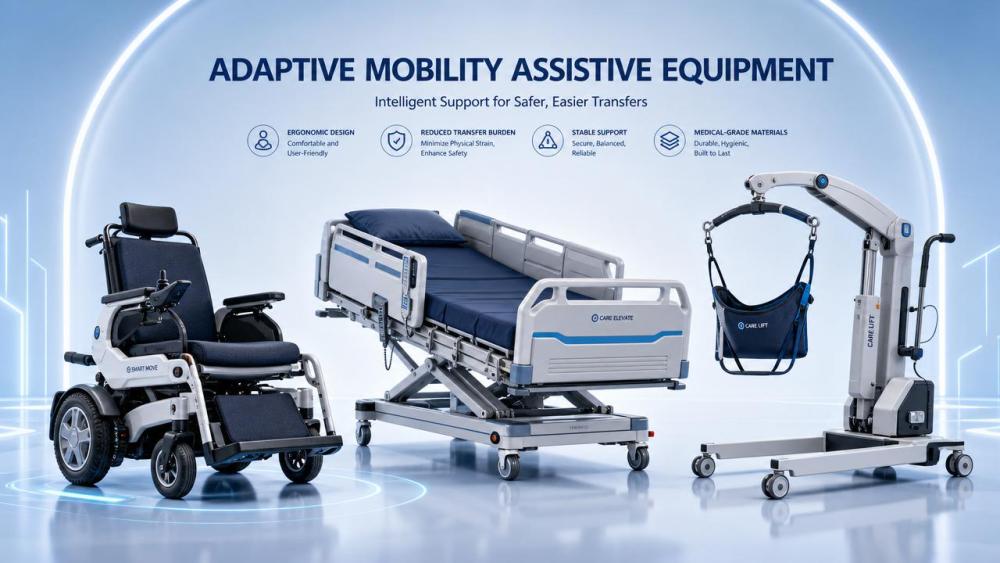
Adaptive mobility equipment includes devices designed to support safer movement with lower physical effort. Common examples include powered wheelchairs, transfer aids, nursing beds, lift systems, standing supports, slide sheets, and robotic assist devices.
Transfer strain usually comes from three sources. These are body weight handling, awkward posture, and unstable movement paths. Good equipment addresses all three at the same time.
A smart transfer system does more than lift. It aligns body position, manages pressure, supports balance, reduces sudden force, and helps both sides of the transfer stay coordinated.
This is why adaptive mobility equipment matters beyond convenience. It directly affects musculoskeletal load, skin protection, fall prevention, fatigue, and long-term confidence during repeated daily transfers.
Key mechanisms behind lower strain
- Weight redistribution through slings, cushions, seat geometry, and adjustable support surfaces.
- Powered assistance that reduces lifting force during sit-to-stand and bed-to-chair movement.
- Stable braking, anti-tip design, and controlled motion that limit sudden shifts.
- Height adjustment that keeps hips, knees, and transfer surfaces better aligned.
- Pressure-sensitive and ergonomic features that improve comfort during repositioning.
Industry context and why transfer efficiency is receiving more attention
Across the comprehensive health and accessibility sector, transfer support is now a central design priority. Aging populations, workforce pressure, home care growth, and safety regulation are all driving this change.
Transfer-related injuries affect both users and operators. Back strain, shoulder stress, falls, friction wounds, and failed repositioning events can create medical, emotional, and operational costs.
Platforms focused on elderly health technology, such as EHAS, closely observe this convergence. Smart mobility wheelchairs, transfer robots, sensor-assisted nursing beds, and accessibility systems now form one connected transfer ecosystem.
This attention is not temporary. Adaptive mobility equipment is increasingly viewed as core infrastructure for safer daily care, rehabilitation continuity, and accessible independent living.
Practical value of adaptive mobility equipment in daily operations
The practical value of adaptive mobility equipment appears in routine moments. Bed exits, bathroom transfers, wheelchair repositioning, and vehicle access all become more manageable with the right support design.
Benefits for user safety and comfort
Users often benefit from smoother movement paths and fewer abrupt lifting motions. That can reduce fear, joint discomfort, skin shear, and the hesitation that makes transfers slower and less stable.
Adaptive mobility equipment can also preserve posture. Better alignment at the hips and trunk supports safer standing pivots, lateral transfers, and seated repositioning.
Benefits for workload and handling strain
Transfer support systems reduce manual force demands. Instead of lifting full body weight, operators guide movement, manage positioning, and supervise stability while the equipment handles load distribution.
This lowers cumulative physical stress. Over time, less bending, twisting, and sudden catching can support healthier handling routines and better consistency across shifts or family care schedules.
Benefits for efficiency and care quality
- Shorter setup time for repeated transfers.
- More predictable movement in tight or wet spaces.
- Improved user cooperation because fear is reduced.
- Better dignity through controlled and private support.
Typical adaptive mobility equipment categories and transfer scenarios
Different transfer challenges call for different solutions. The best adaptive mobility equipment depends on mobility level, environment, body support needs, and how often transfers occur.
In advanced settings, these categories can work together. A pressure-aware bed, a transfer robot, and a stable smart wheelchair can create a much safer movement chain from rest to mobility.
Selection factors that determine real transfer performance
Not every device labeled adaptive mobility equipment will reduce transfer strain equally. Performance depends on matching equipment features to actual transfer tasks and environmental limits.
Core evaluation points
- User mobility level, trunk control, and weight-bearing ability.
- Seat height compatibility between surfaces.
- Turning radius and clearance in bathrooms, hallways, and bedside areas.
- Ease of sling placement, controls, and braking functions.
- Cleaning, maintenance, and battery reliability for powered systems.
Comfort should never be treated as secondary. If equipment feels unstable, noisy, slow, or difficult to enter, users may resist it, which reduces both safety and efficiency.
Interoperability also matters. Adaptive mobility equipment performs better when beds, wheelchairs, bathroom supports, and monitoring systems are designed as one coordinated pathway.
Implementation guidance and common precautions
Successful use depends on preparation, not only hardware. Even high-quality adaptive mobility equipment can underperform if setup, training, or environmental planning is weak.
- Map all routine transfers first, including frequency, destination, and surface height.
- Check flooring, doorway width, wet zones, and charging access.
- Test real transfer sequences, not only product features on paper.
- Train for emergency stops, sling fit, and communication during movement.
- Review outcomes regularly, including strain, comfort, and near-miss events.
A common mistake is choosing only for maximum lifting capacity. Transfer success usually depends more on usability, alignment, support timing, and fit within the real care environment.
Another mistake is separating mobility from fall prevention. The strongest adaptive mobility equipment strategy links movement support with grab bars, sensors, lighting, and accessible room layout.
Next steps for building a safer transfer ecosystem
Adaptive mobility equipment delivers the greatest value when viewed as part of a full accessibility system. Safer transfers depend on equipment, space planning, user fit, and continuous evaluation working together.
A practical next step is to review the most difficult transfer points first. Focus on bed exits, bathroom movement, and repeated chair transfers, then identify where strain, delay, or instability appears most often.
From there, compare adaptive mobility equipment options by transfer type, not by product category alone. The right solution should reduce force, improve confidence, and support dignified daily movement with measurable consistency.
As elderly care technology continues to evolve, adaptive mobility equipment will remain central to independent living, rehabilitation support, and safer human-centered accessibility design.
Related News
- When do transfer robot systems improve safety in patient handling?Sep 12, 2026Care Robotics Architect
- Can ergonomic caregiver assist technology reduce strain during transfers?Sep 02, 2026Care Robotics Architect
- When accessibility systems retrofits are needed for safe patient transfersAug 30, 2026Care Robotics Architect
- What to verify before choosing an intelligent patient transfer robots supplierAug 29, 2026Care Robotics Architect